
Author: Sihan Meng,Leyu Zhu,Pengcheng Shi
Affiliation: RSBM
Email: pengchengshi@biotechrs.com; pcspc9@gmail.com
Abstract
Oral dissolving films (ODFs) transform APIs and nutraceuticals into ultra-thin, fast-dispersing, user-friendly formats—but their large surface area, hygroscopic matrices, and dose-critical nature demand a manufacturing platform fully aligned with Good Manufacturing Practice (GMP) expectations. This paper outlines an integrated model for GMP-ready ODF production, covering facility design, equipment qualification, process validation, cleaning validation, in-line/at-line controls, data integrity, and end-to-end traceability. Using a CPP→CQA and lifecycle validation framework, we map each step—polymer solution prep, coating, drying, slitting, sachet/blister packing—to controls that protect assay, content uniformity, mechanical integrity, and patient safety. We also highlight the role of digital batch records, PAT, and serialized or unit-level traceability to support global regulatory and audit readiness. [1–9]
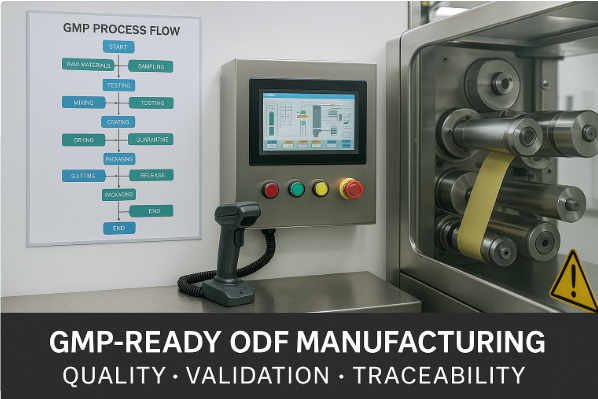
Introduction
ODFs sit at the intersection of solid oral dosage and thin-film coating technology. Compared with tablets and capsules, they:
Expose a high surface-to-mass ratio, increasing sensitivity to moisture, oxygen, and handling.
Depend on tight thickness and content uniformity control across a continuous web.
Are frequently positioned as premium, precise, or pediatric/geriatric-friendly formats, attracting higher regulatory and patient scrutiny.
To be GMP-ready, an ODF platform must show that:
Facilities and utilities support controlled, clean manufacture.
Equipment and processes are qualified, validated, and monitored.
Every strip can be traced—from incoming excipients to final pack—via robust documentation and data integrity. [1–4]
This paper provides a structured approach for building or upgrading such a platform.
Methods
1. Quality by Design (QbD) Framework
Define target product profile (TPP) and critical quality attributes (CQAs), such as:
Assay & content uniformity,
Residual solvent/moisture,
Disintegration time,
Mechanical strength, curl, blocking,
Microbiological quality (where applicable). [2–4]
Identify critical material attributes (CMAs) and critical process parameters (CPPs):
Polymer grade, plasticizer, solids content, viscosity,
Coating gap/flow rate, line speed,
Drying temperature/humidity profile,
Web tension,
Slitting and cutting accuracy,
Packaging barrier & seal integrity.
2. Validation & Qualification Strategy
Use lifecycle validation aligned with ICH/FDA/EMA and PIC/S expectations. [1,5]
Design Qualification (DQ) – Confirm the line concept supports CQAs (layout, zoning, material & personnel flow, HVAC).
Installation Qualification (IQ) – Document correct installation of coater/dryer, PAT, slitter, packaging, utilities.
Operational Qualification (OQ) – Challenge operating ranges for speed, temperature, tension, alarms, interlocks.
Performance Qualification (PQ) – Run consecutive commercial-scale batches demonstrating CQA consistency.
Include:
Cleaning validation (shared equipment, worst-case matrix & actives).
Computer system validation (CSV) of PLC/SCADA, PAT, MES, LIMS, serialization, historian.
3. Traceability & Data Integrity
Implement:
Electronic batch records (EBR) with role-based access, audit trails, e-signatures.
Material traceability:
GRN → Weighing → Solution batch → Coating run → Web ID → Cutting/packing lot → Finished good.
PAT & sensor data capture (NIR for moisture, laser micrometers for thickness, vision for defects).
Optional serialization or unique pouch codes for high-risk / Rx products. [6–9]
Measures
Process & Product Quality
Thickness mean & %CV across web.
Assay & content uniformity (strip-to-strip, lane-to-lane).
Residual moisture/solvent.
Disintegration time & mechanical robustness.
Bioburden / microbial limits (where applicable).
Packaging integrity (seal tests, WVTR/OTR proxies).
Validation & Compliance
Number of validated CPP ranges with supporting data.
Cleaning validation: max carryover vs MACO limits.
CSV: audit trail completeness, backup/restore tests.
Deviation, OOS, and CAPA statistics.
Traceability & Data Integrity
% of batches with fully electronic, review-by-exception capable records.
Time to reconstruct genealogy (materials → batch → distribution).
Incidents of data discrepancies or missing records.
Ability to isolate impacted units in a recall scenario. [5–9]
Results (Illustrative)
Validated Coating–Drying Control
After QbD-driven tuning, web thickness CV% reduced (e.g. from ~5–6% to ≤2–3%), improving content uniformity and reducing rejects. [2–4]
Defined and locked design space for solids content, line speed, and temperature profiles.
Effective Cleaning & Cross-Contamination Control
Swab/rinse studies demonstrate residues below MACO across worst-case APIs/colors.
Documented cleaning procedures support rapid changeover between SKUs while maintaining GMP assurance.
Digital Traceability
Rapid batch review,
Clear genealogy (solution batch → coating lane → packaging lot),
Faster investigations.
End-to-end EBR + integrated PAT enables:
Select products implement unit or pouch-level coding linked to batch/expiry and, if needed, distribution data. [6–9]
Discussion
1. ODF-Specific GMP Risks
Key vulnerabilities vs conventional tablets:
Moisture excursions quickly impact film properties.
Non-uniform coating or drying can create systematic dose bias.
Web handling defects (wrinkles, edge cracks) can silently compromise units.
Shared equipment with liquids and films heightens cleaning complexity.
Mitigation requires:
Robust environmental & moisture control,
Inline monitoring of thickness and visual defects,
Well-defined alarm and response procedures, not just end-testing. [2–4]
2. Role of PAT & Automation
Inline PAT (NIR, lasers, cameras) under a validated framework:
Reduces reliance on slow, manual in-process tests.
Enables real-time trend detection and proactive corrections.
Supports review-by-exception in digital batch release models.
However, PAT systems are themselves GMP-relevant:
Require qualification, calibration, CSV, SOPs, and data integrity controls. [5–8]
3. Data Integrity & Traceability as Non-Negotiables
GMP-ready ODF operations must demonstrate:
ALCOA+ principles:
Attributable, Legible, Contemporaneous, Original, Accurate, plus Complete, Consistent, Enduring, Available.
Seamless linkage between:
Raw material COAs,
Weigh & dispense records,
Process parameters,
Sampling & results,
Packaging & distribution.
This transforms potential vulnerabilities (complex continuous processes, many micro-units) into traceable, defendable histories, crucial for inspections and potential recalls. [6–9]
4. Commercial & Strategic Upside
A mature GMP-ready ODF platform:
Shortens tech transfers and partner audits.
Enables co-branding / OEM / ODM with strong documentation packages.
Justifies premium positioning with a real quality story, not only marketing language.
Conclusion
Building a GMP-ready ODF manufacturing capability means treating thin films as a high-precision, high-visibility dosage form:
Quality is engineered via QbD, robust facilities, qualified equipment, controlled coating–drying–packing, and strong packaging.
Validation spans IQ/OQ/PQ, cleaning, CSV, and PAT, confirming the process is capable and under control over its lifecycle.
Traceability—digital, granular, and audit-ready—connects every strip to its origin and processing history.
Manufacturers who integrate these pillars achieve regulatory confidence, lower risk, and a durable competitive edge in the rapidly growing ODF market.
References
ICH Q8/Q9/Q10 and modern GMP expectations for complex solid dosage forms.
Technical reports on ODF formulation, coating, and drying process control.
EMA/FDA guidance on continuous manufacturing and film coating systems.
QbD case studies for thin oral film products.
PIC/S and FDA process validation guidance (lifecycle approach).
Data integrity guidance for pharmaceutical manufacturing (ALCOA+).
Best practices for PAT implementation in real-time quality control.
Strategies for electronic batch records and review-by-exception.
Traceability, serialization, and recall management in GMP supply chains.