
Author: Sihan Meng,Leyu Zhu,Pengcheng Shi
Affiliation: RSBM
Email: pengchengshi@biotechrs.com; pcspc9@gmail.com
Abstract
For oral dissolving film (ODF) manufacturing, the choice between slot-die and comma coating determines achievable dose accuracy, yield, scalability, and overall cost-per-sachet. This paper compares both technologies through a structured CPP→CQA lens: flow behavior, coating window, edge control, changeover, and integration with drying and inline PAT. We present illustrative metrics, an operating-window map, and a technology-fit radar to support decision-making for both R&D and commercial lines. Results indicate that slot-die excels in low-dose, tight-uniformity, and high-speed applications, while comma offers robustness, simplicity, and flexibility for development and broader viscosity ranges—when paired with disciplined drying and web handling. [1–9]
Introduction
ODFs require uniform thickness, precise coat weight, and clean edges across thin, often sensitive formulations. Coating technology is not a cosmetic choice: it directly impacts assay RSD%, thickness CV%, scrap, and feasibility of real-time release.
Two leading options:
Slot-die coating: pre-metered, enclosed head; excellent for precision and low coat-weight at scale; more sensitive to rheology, filtration, and setup.
Comma (knife-over-roll/bed): post-metered, open, mechanically intuitive; strong for flexibility, quick changes, and robust handling of varied systems; inherently more edge loss and thickness variability. [1–4]
This paper provides a practical comparison tailored to ODF lines.
Methods
Comparative framework
Map to CQAs: thickness CV%, assay RSD%, residual moisture, defects (streaks, chatter, edge cracks), pouch reject ppm.
Map to CPPs: viscosity vs shear rate, slot-die lip gap/profile, comma gap, line speed, pump stability, dryer ΔT / air velocity, web tension. [2–5]
Illustrative performance modeling
Thickness CV%
Edge trim loss %
Min achievable wet film thickness
Changeover time (setup/clean). [3–6]
Construct benchmark scenarios for a nutraceutical ODF (low-dose) and a higher-load functional film.
Estimate relative:
Operating window visualization
Generate a conceptual viscosity vs coat-weight map, overlaying feasible “windows” for slot-die and comma coating. [2–4]
Technology fit scoring
Score each method (1–5) on: low-dose accuracy, high-speed potential, R&D flexibility, CapEx, setup robustness, edge quality. [1–3,6–8]
Measures
Coating quality: thickness mean & CV%, cross-web profile (P–V), visible defects.
Yield & efficiency: edge trim %, start-up scrap, cleaning time, changeover duration.
Process robustness: sensitivity to viscosity drift, entrained bubbles, solids% changes, web tension variation.
Commercial fit: scalability to 24/7, ability to pair with inline PAT (NIR, laser micrometers, vision), and integration into multi-zone drying. [3–9]
Results
1. Key performance metrics (illustrative)
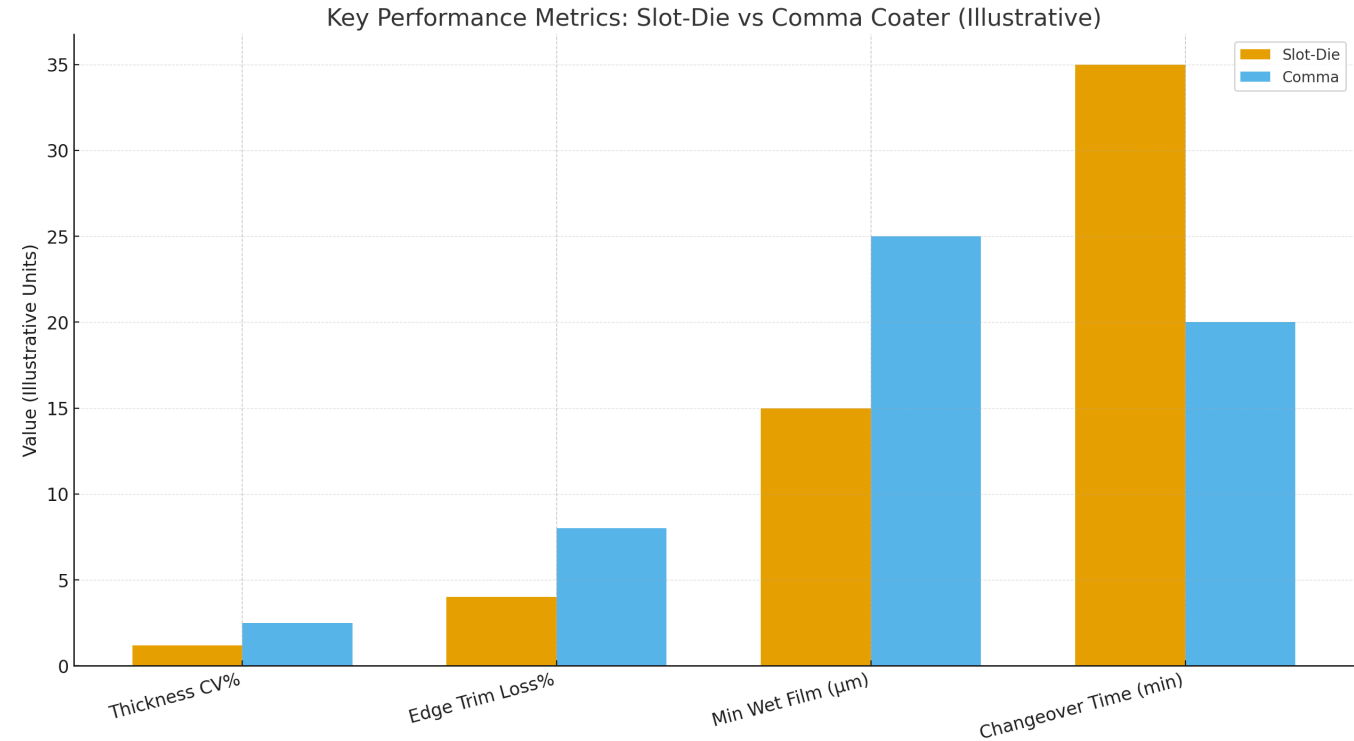
Figure 1 compares core KPIs:
Slot-die: lower thickness CV% (~1.2%), edge loss (~4%), supports thinner wet films (e.g., 15 µm+) but somewhat longer changeover due to enclosed manifolds and cleaning.
Comma: higher CV% (~2.5%), edge loss (~8%), typically thicker minimum films, but faster setup & cleaning, attractive in multi-formula environments. [2–5]
2. Coating window comparison
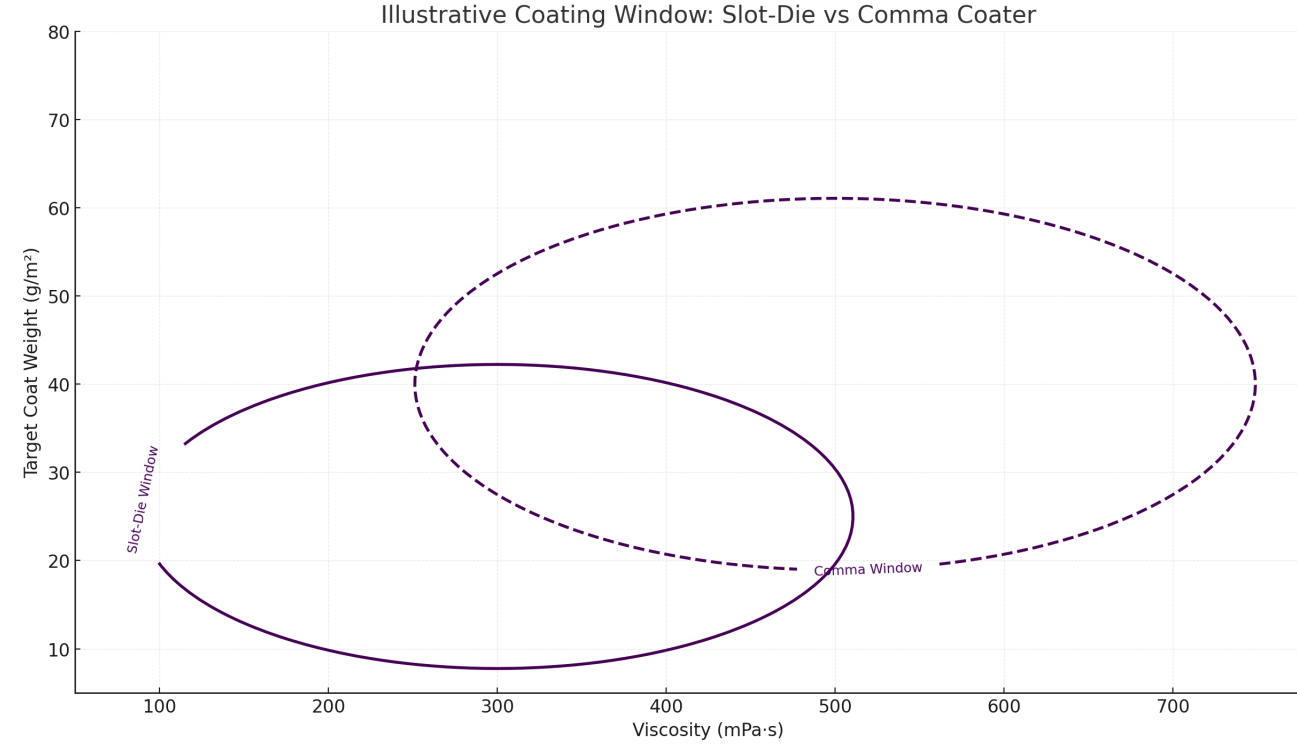
Figure 2 shows an illustrative coating window:
Slot-die prefers narrower viscosity bands with well-controlled rheology and excels at low coat weights (e.g., 10–30 g/m²) ideal for low-dose ODFs.
Comma accommodates wider viscosity ranges and moderate–higher coat weights (e.g., 30–60 g/m²), fitting higher-load films or early development where formulations move frequently. [2–4]
3. Technology fit radar
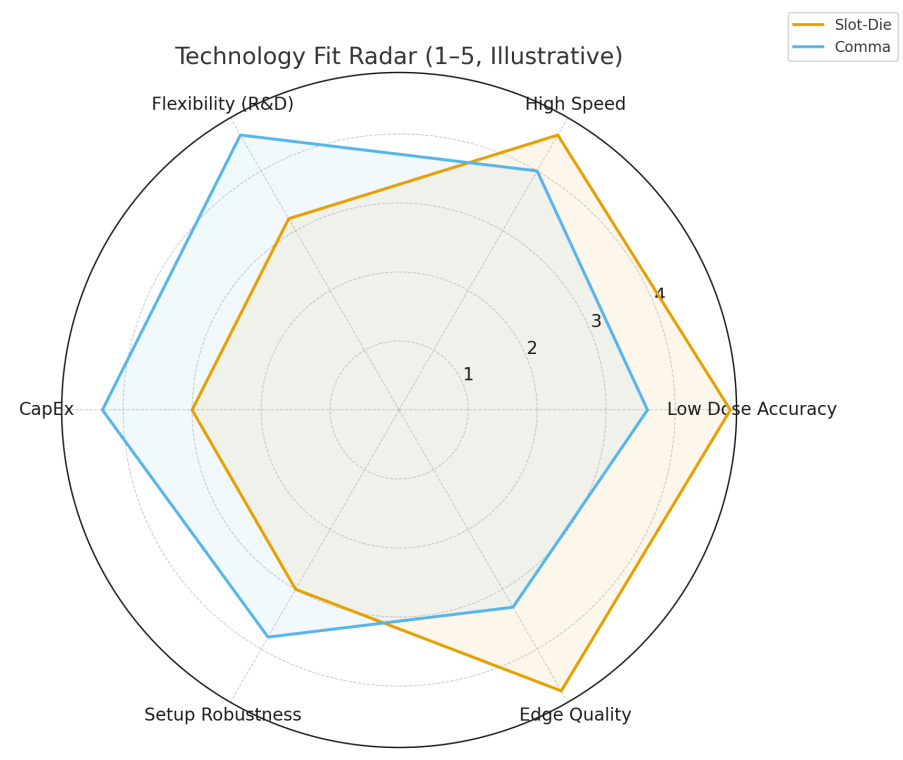
Figure 3 summarizes strategic fit:
Slot-die scores highest on low-dose accuracy, high speed, edge quality.
Comma leads on CapEx efficiency and R&D flexibility, with robust behavior during trialing and frequent SKUs. [1–3,6–8]
Discussion
When to choose Slot-Die
Choose slot-die if:
Low or potent dose: You need tight assay RSD% and minimal thickness variability.
High-volume SKUs: 24/7, long campaigns, where reduced edge trim and scrap repay higher CapEx.
Integrated PAT: Enclosed head + stable film = ideal for laser thickness, NIR moisture, and vision-based release.
You can enforce good rheology discipline: filtration, degassing, consistent solids%, and robust pump control. [2–5,7]
When to choose Comma
Choose comma if:
Formulation is evolving: early-stage or custom/OEM work needing frequent parameter changes.
You run higher coat weights or more forgiving CQAs.
You want lower initial CapEx and mechanically intuitive setup for operators.
You can tolerate some extra edge trim and modestly higher thickness CV%, controlled via tension, gap, and dryer tuning. [1–3,6]
Hybrid strategy
Many ODF manufacturers:
Start with comma for feasibility and SKUs with wider specs.
Add slot-die for flagship, low-dose, or premium lines where precision and yield matter most.
Share drying, slitting, pouching, and PAT infrastructure across both, with recipes tuned per head. [4,7–9]
Conclusion
Both slot-die and comma coaters can produce compliant, high-quality ODFs—if aligned with the right product profile, process discipline, and PAT strategy. As a rule of thumb:
Pick slot-die for precision, potency, and scale.
Pick comma for flexibility, simplicity, and development agility.
Framing the decision through CPP→CQA, yield, and lifecycle cost—rather than habit or vendor bias—leads to ODF lines that are technically robust and commercially competitive.
References
Coating technology selection frameworks for pharmaceutical and nutraceutical webs.
Slot-die fundamentals: pre-metered flow, lip design, manifold distribution, and edge-bead control.
Comma/knife-over-roll coating: gap control, fluid rheology, and practical limits for thin films.
ODF-specific CPP→CQA mapping: coat weight, thickness CV%, residual moisture, and dose uniformity.
Multi-zone drying and web handling interactions with different coating heads.
Scale-up considerations: from R&D coater to commercial line for thin polymeric films.
Integration of inline PAT (NIR, laser micrometers, vision) with precision coating processes.
Economic analyses: CapEx, edge-trim losses, changeover time, and cost-per-dose.
Case examples of mixed-technology ODF plants (development vs high-volume production lines).