
Author: Sihan Meng, Leyu Zhu, Pengcheng Shi
Affiliation: RSBM
Email: pengchengshi@biotechrs.com; pcspc9@gmail.com
Abstract
Oral dissolving films (ODFs) have emerged as a versatile dosage form for pharmaceuticals, nutraceuticals, and regulated consumer products due to their rapid onset, patient compliance, and precise dosing. However, scaling ODF production from pilot testing to mass manufacturing remains challenging. This paper systematically analyzes common pitfalls encountered during ODF amplification—including formulation instability, coating and drying non-uniformity, scale-dependent process drift, and quality control failures—and proposes practical, engineering-oriented solutions. By integrating formulation science with process control, equipment design, and GMP-aligned quality systems, this work provides a structured framework to de-risk scale-up and enable robust commercial production.
Introduction
Oral dissolving films are thin polymeric strips designed to disintegrate rapidly in the oral cavity, delivering active ingredients through oral mucosa or gastrointestinal absorption. Pilot-scale ODF development typically focuses on proof-of-concept, palatability, and short-run feasibility. However, parameters that appear stable at laboratory or pilot scale often fail when transferred to continuous or semi-continuous industrial lines [1].
The transition from pilot testing to mass production—here referred to as ODF amplification—introduces nonlinear changes in heat transfer, solvent evaporation, shear stress, and residence time. Without systematic amplification strategies, manufacturers face batch failures, inconsistent content uniformity, and regulatory non-compliance. This paper aims to bridge the gap between pilot success and industrial reliability by identifying recurring scale-up pitfalls and proposing actionable solutions.
Methods
This study is based on a combined methodological approach:
Process Mapping: Deconstruction of the ODF manufacturing workflow (solution preparation, casting, drying, slitting, die-cutting, and packaging).
Scale Comparison: Side-by-side comparison of pilot-scale (≤5 m/min coating speed) and industrial-scale (>15 m/min coating speed) parameters.
Failure Mode Analysis: Identification of common failure modes observed during scale-up trials.
Engineering Validation: Evaluation of corrective strategies through repeated industrial trial runs under GMP-like conditions.
Data were collected from multiple ODF projects covering APIs, nutraceutical actives, and nicotine-related compounds.
Measures
Key performance and quality indicators were used to assess scale-up success:
Content Uniformity (CU): Relative standard deviation (RSD) of active content across film area.
Thickness Variation: Measured via inline and offline micrometry.
Residual Solvent Content: Determined by loss-on-drying and gas chromatography where applicable.
Mechanical Integrity: Tensile strength and elongation at break.
Dissolution Time: In vitro disintegration in simulated saliva.
Acceptance criteria were aligned with pharmacopeial guidance and internal GMP specifications [2].
Results
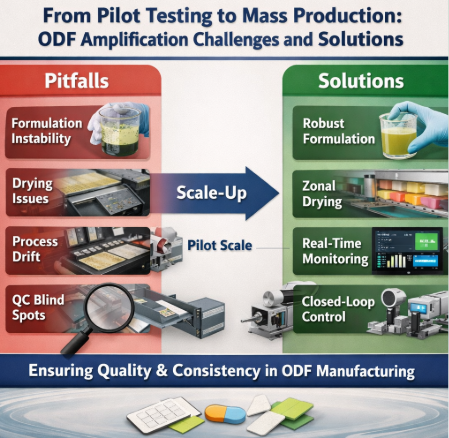
The analysis identified four dominant categories of pitfalls:
Formulation Instability
Pilot formulations often rely on narrow viscosity windows. At scale, prolonged mixing and recirculation induce polymer degradation or phase separation, leading to streaking and dose variability.Drying Mismatch
Drying conditions optimized at pilot scale frequently fail at higher line speeds. Insufficient solvent removal causes film tackiness, while excessive heat leads to brittleness and active degradation.Process Drift During Continuous Operation
Long production runs introduce cumulative errors in coating gap, pump flow rate, and web tension, which are negligible in short pilot batches.Quality Control Blind Spots
Pilot testing relies heavily on end-point testing. In mass production, the absence of real-time monitoring delays defect detection and increases scrap rates.
Discussion
The findings demonstrate that ODF amplification is not a linear scaling exercise. Instead, it requires re-engineering of both formulation and process parameters. Key solutions include:
Formulation Buffering: Designing viscosity and solids-content buffers that tolerate shear and thermal stress at scale [3].
Zonal Drying Architecture: Implementing multi-zone drying with independent temperature and airflow control to decouple solvent removal from thermal exposure [4].
Closed-Loop Process Control: Using inline sensors for thickness and weight to correct deviations in real time.
Scale-Appropriate Validation: Conducting validation runs at commercial speeds rather than extrapolating from pilot data.
These strategies shift ODF manufacturing from experience-driven to data-driven scale-up.
Conclusion
Scaling ODF production from pilot testing to mass manufacturing presents distinct and recurring challenges that cannot be resolved by simple parameter multiplication. Successful ODF amplification requires an integrated approach combining formulation robustness, equipment design, process analytics, and GMP-aligned quality systems. By proactively addressing common pitfalls, manufacturers can achieve stable, high-throughput ODF production while maintaining product quality and regulatory compliance.
References
Dixit, R. P., & Puthli, S. P. (2009). Oral strip technology: Overview and future potential. Journal of Controlled Release, 139(2), 94–107.
European Pharmacopoeia Commission. (2023). Uniformity of dosage units. European Pharmacopoeia.
Cilurzo, F., et al. (2011). Fast dissolving films made of maltodextrins. European Journal of Pharmaceutics and Biopharmaceutics, 77(1), 47–54.
Kunte, S., & Tandale, P. (2010). Fast dissolving strips: A novel approach for the delivery of verapamil. Journal of Pharmaceutical Bioallied Sciences, 2(4), 325–328.