
Author: Sihan Meng, Leyu Zhu, Pengcheng Shi
Affiliation: RSBM
Email: pengchengshi@biotechrs.com; pcspc9@gmail.com
Abstract
Moisture content is a critical yet frequently underestimated parameter in the manufacturing and performance of oral dissolving films (ODFs). Small deviations in residual water content can dramatically alter mechanical properties, leading to brittleness, cracking, excessive adhesion, or handling failures during processing and use. This paper systematically examines the role of moisture in oral film systems, explaining its physicochemical interactions with polymer matrices and plasticizers. Through process-oriented analysis, we identify optimal moisture windows, common failure modes during drying and storage, and practical strategies for controlling water content across pilot and mass-production scales. The findings highlight moisture control as a central determinant of both product quality and manufacturing robustness.
Introduction
Oral dissolving films are thin polymeric dosage forms designed to rapidly hydrate, disintegrate, and release active ingredients in the oral cavity. Their performance depends on a delicate balance between mechanical integrity and fast dissolution. Among the many variables influencing this balance, moisture content plays a dominant role [1].
In pilot-scale development, moisture is often treated as a secondary outcome of drying conditions rather than a controlled quality attribute. However, during scale-up and commercial production, uncontrolled moisture variation becomes a primary cause of brittleness, curling, blocking, and adhesion to packaging materials [2]. Understanding how water functions within polymeric oral films—as both a plasticizer and a destabilizing agent—is essential for reproducible manufacturing.
This paper focuses on why moisture content determines brittleness and adhesion in oral films and how it can be systematically controlled.
Methods
The analysis integrates formulation science with manufacturing process evaluation using the following approaches:
Polymer System Review
Examination of commonly used oral film polymers, including pullulan, hydroxypropyl methylcellulose (HPMC), polyvinyl alcohol (PVA), and maltodextrin-based systems.Process Condition Mapping
Assessment of casting, drying, equilibration, and packaging stages where moisture content is gained or lost.Moisture–Property Correlation
Correlation of residual moisture levels with mechanical behavior observed during slitting, die-cutting, and pouching.Scale Sensitivity Analysis
Comparison of moisture variability between pilot-scale batches and continuous industrial runs.
Measures
Moisture-related performance was evaluated using the following indicators:
Residual Moisture Content (%)
Measured by loss-on-drying (LOD) and Karl Fischer titration where applicable.Mechanical Brittleness
Assessed qualitatively (cracking, edge chipping) and quantitatively via tensile strength and elongation at break.Adhesion and Blocking Tendency
Observed as film-to-film sticking, adhesion to release liners, or pouch inner surfaces.Dimensional Stability
Curling, warping, and shrinkage after drying and during storage.
Target ranges were defined based on polymer type and intended packaging configuration [3].
Results
The results demonstrate a strong, non-linear relationship between moisture content and oral film performance:
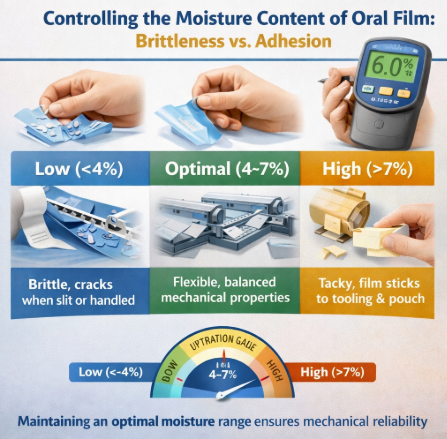
Low Moisture Content (<3–4%)
Films exhibit increased brittleness, micro-cracking during slitting, and poor resistance to handling stress. This is especially pronounced in pullulan- and maltodextrin-rich systems.Optimal Moisture Window (Typically 4–7%)
Films show balanced flexibility and strength, with minimal cracking and acceptable adhesion behavior. Water acts as a secondary plasticizer, complementing glycerol or PEG.High Moisture Content (>7–9%)
Excessive softness, tackiness, and adhesion to tooling and packaging materials are observed. Films may block during stacking or adhere to pouch inner layers.
These trends were consistent across multiple formulations, though the exact thresholds varied by polymer composition.
Discussion
Water in oral films plays a dual role. At controlled levels, it reduces intermolecular hydrogen bonding between polymer chains, increasing flexibility and toughness [4]. However, excessive or insufficient water disrupts this balance.
From a manufacturing perspective, moisture-related failures often originate from:
Over-drying driven by high-temperature, single-zone drying systems.
Post-drying moisture loss in low-humidity environments prior to packaging.
Moisture gain during storage due to inadequate barrier properties of packaging films.
Crucially, moisture control must be treated as a critical quality attribute (CQA) rather than a passive outcome of drying. Industrial-scale solutions include zonal drying, controlled equilibration steps, and humidity-managed packaging environments [5].
Conclusion
Moisture content is a primary determinant of brittleness and adhesion in oral dissolving films. Both under- and over-drying lead to predictable and preventable failure modes that compromise product quality and process efficiency. By defining polymer-specific moisture windows and implementing robust process and environmental controls, manufacturers can significantly improve the mechanical reliability and consistency of oral film products. Effective moisture management is therefore foundational to successful scale-up and long-term commercial production.
References
Preis, M., Knop, K., & Breitkreutz, J. (2013). Mechanical strength test for orodispersible films. International Journal of Pharmaceutics, 461(1–2), 22–29.
Borges, A. F., Silva, C., Coelho, J. F. J., & Simões, S. (2015). Oral films: Current status and future perspectives. Journal of Controlled Release, 206, 1–19.
Cilurzo, F., Cupone, I. E., Minghetti, P., Buratti, S., & Gennari, C. G. (2008). Nicotine fast dissolving films made of maltodextrins. European Journal of Pharmaceutics and Biopharmaceutics, 70(3), 895–900.
Peh, K. K., & Wong, C. F. (1999). Polymeric films as vehicle for buccal delivery. Journal of Pharmacy & Pharmaceutical Sciences, 2(2), 53–61.
Kunte, S., & Tandale, P. (2010). Fast dissolving strips: A novel approach for the delivery of verapamil. Journal of Pharmaceutical Bioallied Sciences, 2(4), 325–328.