
Author: Sihan Meng, Leyu Zhu, Pengcheng Shi
Affiliation: RSBM
Email: pengchengshi@biotechrs.com; pcspc9@gmail.com
Abstract
The dissolution rate of Oral Disintegrating Films (ODFs) is a defining performance attribute that directly influences onset of action, user experience, and dose reliability. Unlike conventional solid dosage forms, ODF dissolution is governed by a complex interplay of polymer physics, formulation composition, film microstructure, and manufacturing conditions. This paper identifies and analyzes eight key factors that determine ODF dissolution behavior. By linking these factors to measurable quality attributes and scalable manufacturing considerations, the study provides a practical framework for designing fast, consistent, and mass-producible ODF products.
Introduction
Oral Disintegrating Films are thin polymeric matrices designed to rapidly hydrate, disintegrate, and release active ingredients in the oral cavity without the need for water. Fast and reproducible dissolution is central to the value proposition of ODFs in pharmaceutical, nutraceutical, and consumer health applications [1].
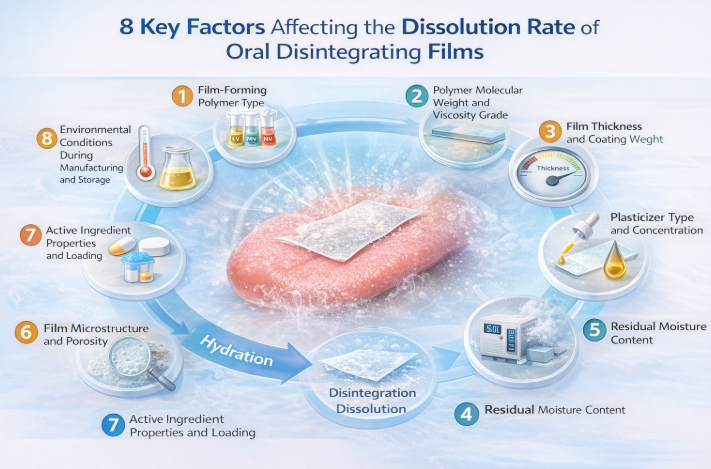
However, dissolution rate is often misunderstood as a single-parameter outcome that can be adjusted late in development. In practice, dissolution is an emergent property determined by upstream decisions in polymer selection, formulation design, coating, drying, and environmental control [2]. This paper systematically examines the eight most influential factors affecting ODF dissolution rate and explains how they interact.
Methods
This analysis integrates peer-reviewed literature, pharmacopeial guidance, and industrial ODF manufacturing experience. Each factor was evaluated in terms of its mechanistic impact on hydration, polymer chain mobility, and matrix disintegration. Relationships between critical material attributes (CMAs), critical process parameters (CPPs), and dissolution-related critical quality attributes (CQAs) were mapped to provide actionable development guidance [3].
Factor 1: Film-Forming Polymer Type
The choice of polymer is the primary determinant of dissolution behavior. Polymers differ in hydrophilicity, chain entanglement density, and hydration kinetics.
Highly water-soluble polymers tend to dissolve faster.
Polymers forming gel layers may slow apparent dissolution.
Polymer chemistry sets the theoretical upper limit of dissolution speed [4].
Factor 2: Polymer Molecular Weight and Viscosity Grade
Higher molecular weight or higher viscosity-grade polymers increase chain entanglement and slow water penetration.
Low–medium molecular weight polymers favor rapid dissolution.
Excessively low molecular weight may compromise mechanical integrity.
An optimal balance is required to achieve both fast dissolution and film robustness [5].
Factor 3: Film Thickness and Coating Weight
Dissolution time scales with diffusion distance.
Thicker films require longer hydration and breakup times.
Uniform thickness is as important as absolute thickness.
Variability in coating weight often causes variability in dissolution performance [6].
Factor 4: Plasticizer Type and Concentration
Plasticizers reduce intermolecular forces and lower the effective glass transition temperature (Tg) of the film.
Proper plasticization accelerates polymer chain mobility during hydration.
Over-plasticization can create tacky films and slow disintegration due to gel formation.
Plasticizer selection directly influences both dissolution rate and storage stability [7].
Factor 5: Residual Moisture Content
Residual moisture acts as an internal plasticizer.
Moderate residual moisture accelerates initial hydration and disintegration.
Over-dried films often dissolve more slowly and exhibit brittle fracture instead of uniform disintegration.
Residual moisture must be designed, not eliminated [8].
Factor 6: Film Microstructure and Porosity
Drying conditions determine internal film structure.
Gradual solvent removal promotes uniform microstructure and faster hydration.
Rapid surface drying can create dense skins that delay dissolution.
Microstructural control is a hidden but critical determinant of dissolution rate [9].
Factor 7: Active Ingredient Properties and Loading
Active ingredients influence dissolution through their solubility, particle size, and loading level.
Low-dose, water-soluble actives minimally affect dissolution.
High loading or poorly soluble actives can block water pathways and slow film breakup.
Formulation strategies must account for active–polymer interactions [10].
Factor 8: Environmental Conditions During Manufacturing and Storage
Humidity and temperature affect polymer mobility and moisture equilibrium.
Films conditioned at inappropriate humidity may show altered dissolution behavior at use.
Environmental drift causes batch-to-batch variability even with identical formulations.
Controlled environments are essential for dissolution consistency [11].
Measures
Dissolution performance and consistency are evaluated using [12,13]:
Disintegration time
In vitro dissolution profiles
Residual moisture content
Film thickness and uniformity
Mechanical properties correlated with hydration behavior
These measures link formulation and process decisions to functional outcomes.
Results
Across development and manufacturing experience, polymer selection, film thickness, and residual moisture emerge as the most dominant factors influencing dissolution rate. However, optimal performance is achieved only when all eight factors are harmonized. Attempts to accelerate dissolution by adjusting a single variable often introduce instability or manufacturability issues [14].
Discussion
Fast dissolution is not synonymous with weak structure. The most successful ODFs achieve rapid hydration while maintaining sufficient mechanical integrity for processing and handling. This balance requires early integration of dissolution targets with formulation design and drying strategy.
From a scale-up perspective, dissolution rate must remain stable under realistic manufacturing and storage environments. Designs that rely on extreme plasticization or ultra-thin films are often fragile in mass production [15].
Conclusion
The dissolution rate of Oral Disintegrating Films is governed by eight interdependent factors spanning materials, formulation, process, and environment. Understanding and controlling these factors enables the rational design of ODFs that dissolve rapidly, consistently, and reliably at scale. Rather than treating dissolution as a late-stage adjustment, it should be engineered from the earliest stages of product development.
References
Fu Y et al. Expert Opin Drug Deliv. 2004;1(4):673–690.
Preis M. J Pharm Pharmacol. 2013;65(2):157–170.
Cilurzo F et al. Eur J Pharm Biopharm. 2008;70(3):895–900.
Dixit RP, Puthli SP. J Control Release. 2009;139(2):94–107.
Bala R et al. Int J Pharm Investig. 2013;3(2):67–76.
Morales JO, McConville JT. Ther Deliv. 2011;2(5):637–646.
Sperling LH. Introduction to Physical Polymer Science. Wiley; 2005.
Hoffmann EM et al. Pharm Res. 2011;28(8):1914–1922.
Kistler SF, Schweizer PM. Liquid Film Coating. Chapman & Hall; 1997.
Borges AF et al. Int J Pharm. 2015;494(1):332–339.
ICH Q10 Pharmaceutical Quality System.
USP <701> Disintegration Test.
USP <905> Uniformity of Dosage Units.
Keshari R, Keshari S. J Drug Deliv Ther. 2014;4(4):1–7.
Preis M. Drug Dev Ind Pharm. 2013;39(7):1049–1057.