
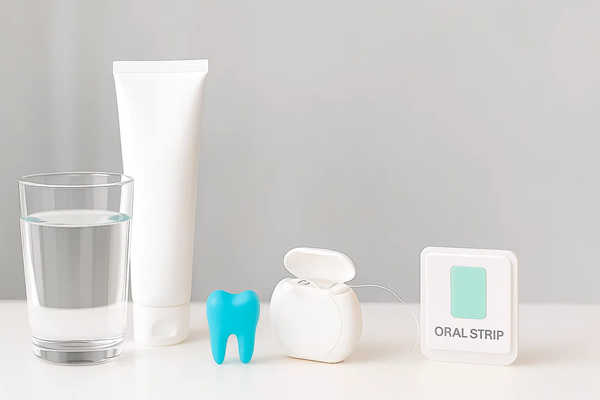
fresh breath strip
Short Description:
Oral Care ODF (Oral Dissolving Film / Oral Thin Film) are ultra-thin, on-tongue/ buccal strips that dissolve rapidly to freshen breath, support daily oral hygiene, and deliver targeted care (e.g., gum health, enamel remineralization, local cleansing). Compared with mouthwash or sprays, ODF are more portable, precisely dosed, and fast-acting—ideal for commuters, aligner/brace wearers, people with dysphagia, and anyone needing on-the-go oral care.
Product Video
Sample Diagram
Performance & Features
Designed around real users, Oral Care ODF balance experience, efficacy, and safety.
Experience: the strip dissolves in 30–90 seconds, spreading evenly across the oral cavity to provide an immediate clean, cool feel. Sugar-free systems (e.g., xylitol, erythritol) help reduce caries risk while delivering pleasant sweetness; pH is tuned to a mild 6.0–7.0 for sensitive gums.
Efficacy: close contact with mucosa increases the local availability of functional ingredients where they matter most—xylitol and zinc salts can address malodor sources, fluoride or hydroxyapatite supports enamel remineralization, and gentle antibacterials (e.g., CPC) assist oral hygiene; for night-time dryness or persistent breath issues, optional micro-structured matrices can modestly extend flavor longevity and perceived cleanliness.
Safety & Compliance: we prioritize food/cosmetics-grade ingredients, clearly label potential allergens, offer alcohol-free versions, and control microbiology and heavy metals per relevant standards. Unit-dose packs minimize cross-contamination and misuse.
Portability & Adoption: single-use sachets or blisters fit wallets or pockets, making “tear-and-use” simple across commute, meetings, post-meal, or mask-wearing scenarios. The result is a low-friction habit loop that encourages consistent oral-care behavior. Altogether, the format elevates everyday hygiene without requiring water, a sink, or extra time, while preserving precise dosing and a consistently pleasant mouthfeel—key to repeat use and strong word-of-mouth.
Work station details
The value of Oral Care ODF comes from localized action plus immediate sensory payoff. Upon placement, the film hydrates and spreads uniformly, reaching tongue dorsum, gumline, and soft tissue areas that sprays or quick rinses often miss. No water is needed, which removes situational barriers (travel, office, transit). We tailor sensory profiles to different audiences: for example, a three-phase curve—clean mint top note → gradual cooling → light, long-lasting after-taste. For children and sensitivity-prone users, we balance sweetness/acidity and apply mild cooling agents (e.g., small amounts of WS-3/WS-23).
Formulation engineering typically combines edible film-formers (e.g., HPMC, pullulan, gelatin/pectin systems) with plasticizers (glycerol, propylene glycol) and hydrophilic fillers (maltodextrin) to tune strength, disintegration, and mouthfeel. Stability and uniformity of actives can be supported by micro/nano-dispersion, amorphous solid dispersion, or encapsulation. We balance “melt-in-mouth” and robust handling by controlling thickness (60–120 μm) and water activity (aw ≤ 0.60), preventing blocking under heat/humidity.
Packaging choices include high-barrier sachets for single units or multi-count blister packs with desiccant inside cartons.
Stability programs at 25 °C/60%RH and 40 °C/75%RH track flavor integrity, mechanical strength, and active retention; release testing includes thickness uniformity, content uniformity (e.g., RSD ≤ 6%), and disintegration. With the “Pleasant—Portable—Predictable” design principle, Oral Care ODF fit seamlessly into daily routines and empower users to maintain fresh breath and oral cleanliness anytime, anywhere.
Technical Parameters
Suggested SKUs (customizable by market/regulatory needs): single-strip size 20×30 mm (≈6 cm²) or 25×35 mm (≈8.75 cm²); thickness 60–120 μm; strip mass 80–200 mg.
Representative actives & excipients (development placeholders; final levels must follow local regulations and label claims): xylitol 50–300 mg/strip; zinc salts (e.g., zinc gluconate) 0.5–3 mg/strip; gentle antibacterial (e.g., CPC) as permitted; fluoride or hydroxyapatite per applicable cosmetic/OTC rules; flavor system 0.5–3% (solids), cooling agents 0.05–0.3% depending on audience.
Performance targets: disintegration ≤ 90 s; pH 6.0–7.0; moisture 3–8%; water activity aw ≤ 0.60; thickness uniformity ±10 μm; content uniformity RSD ≤ 6%; tensile strength 20–60 MPa; elongation at break 5–25%.
Micro & safety: TAMC/TYMC within food/cosmetics limits; heavy metals and residual solvents compliant with local standards.
Stability: 24-month target at 25 °C/60%RH (sensory, mechanics, and actives maintained); 6-month accelerated at 40 °C/75%RH for trend analysis.
Packaging: unit-dose high-barrier sachets (e.g., WVTR ≤ 0.5 g/m²·day, OTR ≤ 1 cc/m²·day) or blisters with desiccant; GS1 barcode, batch/lot for traceability.
Manufacturing: aqueous solution casting → gradient drying (50–70 °C) → in-line thickness control → slitting → unit packaging; critical control points include coat weight, drying window, web tension, and static elimination.
QA & labeling: define organoleptic specs (cooling onset, after-taste length), declare allergens, offer alcohol-free and sugar-free claims where appropriate, and align with the intended category (cosmetics/OTC/dental hygiene). All values are indicative development targets; confirm with pilot data, sensory panels, and regulatory review for your destination market.
Previous:Allergy ODF
Next:No Information