Author: Sihan Meng, Leyu Zhu, Pengcheng Shi
Affiliation: RSBM
Email: pengchengshi@biotechrs.com; pcspc9@gmail.com
Abstract
Oral dissolving film (ODF) manufacturing has transitioned from small-scale, formulation-centric production to an integrated, data-driven industrial process. Growing demand across pharmaceutical, nutraceutical, and functional consumer markets requires manufacturers to deliver consistent quality at scale while meeting increasingly stringent regulatory expectations. This paper redefines ODF manufacturing by examining modern approaches that integrate formulation science, automated equipment, process analytics, and Good Manufacturing Practice (GMP) systems. The analysis highlights how reengineered manufacturing paradigms improve reproducibility, scalability, and time-to-market for next-generation ODF products.
Keywords: Oral dissolving film, manufacturing innovation, automation, GMP, scalable production
Introduction
Oral dissolving films offer rapid disintegration, precise dosing, and high user compliance, positioning them as a compelling alternative to traditional oral dosage forms [1]. As ODF applications expand beyond niche indications, manufacturing requirements have intensified, exposing limitations of legacy batch-based and labor-dependent processes.
Historically, ODF production emphasized formulation feasibility over industrial robustness, often resulting in variability during scale-up. Redefining ODF manufacturing requires a shift toward integrated process design, where formulation, equipment, and quality systems are developed concurrently [2]. This paper explores the principles and outcomes of this modern manufacturing approach.
Methods
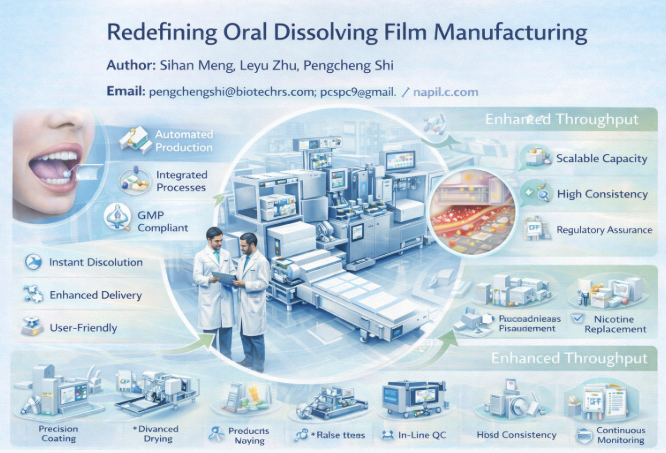
A technical and operational review methodology was employed. Peer-reviewed literature, pharmacopeial standards, and regulatory guidance were analyzed alongside industrial manufacturing practices. Manufacturing workflows were evaluated across solution preparation, film casting, drying, cutting, inspection, and packaging. Particular attention was paid to automation, in-line monitoring, and GMP-aligned documentation.
Measures
Manufacturing performance under a redefined ODF paradigm was assessed using the following measures:
Process consistency – control of film thickness, weight variation, and drying uniformity across production runs [3].
Automation effectiveness – reduction of operator-dependent variability and manual interventions [4].
Scale-up reliability – successful transfer from pilot to commercial production without reformulation [5].
Quality compliance – adherence to GMP requirements, validation, and traceability standards [6].
Operational efficiency – improvements in throughput, yield, and development timelines [7].
Results
Modernized ODF manufacturing systems demonstrate significantly improved reproducibility compared with traditional batch-based approaches. Automated casting and controlled drying reduce thickness variability and defect rates, supporting higher line speeds and consistent output [3,4].
Integration of in-line inspection and process data collection enables real-time quality oversight and faster deviation response. Manufacturers adopting these practices report improved validation outcomes and reduced time-to-market for new ODF products [6,7].
Discussion
Redefining ODF manufacturing represents a paradigm shift from formulation-driven experimentation to engineering-driven process control. Automation and data integration allow manufacturers to anticipate and mitigate variability before it impacts product quality.
This approach also facilitates regulatory alignment by embedding quality into process design rather than relying solely on end-product testing. As ODF markets mature, manufacturers that adopt redefined manufacturing strategies will be better positioned to support customization, global distribution, and long-term scalability [5,8].
Conclusion
Redefined oral dissolving film manufacturing integrates formulation science, automated equipment, and GMP-oriented quality systems into a cohesive production model. This paradigm delivers consistent, scalable, and compliant ODF products while reducing development risk and operational complexity. Embracing this modern manufacturing framework is essential for meeting the evolving demands of next-generation oral delivery markets.
References
Dixit RP, Puthli SP. Oral strip technology: Overview and future potential. J Control Release. 2009;139(2):94–107.
Hoffmann EM, Breitenbach A, Breitkreutz J. Advances in orodispersible films for drug delivery. Expert Opin Drug Deliv. 2011;8(3):299–316.
Preis M, Knop K, Breitkreutz J. Mechanical and process properties of oral films. Int J Pharm. 2014;461(1–2):22–29.
Krampe R, Visser JC, Frijlink HW, Breitkreutz J, Woerdenbag HJ. Oromucosal film preparations: manufacturing considerations. Eur J Pharm Biopharm. 2016;104:1–13.
Krampe R, Breitkreutz J. Scale-up and in-line monitoring in oral film manufacturing. Pharm Dev Technol. 2017;22(2):195–204.
USP <795> and <905>. United States Pharmacopeia. United States Pharmacopeial Convention; 2023.
FDA. Guidance for Industry: Process Validation—General Principles and Practices. U.S. Food and Drug Administration; 2011.
World Health Organization. WHO Technical Report Series: Good Manufacturing Practices. WHO; 2020.