
Too Slow, Too Inconsistent? How We Used Data to Stabilize T₉₀ at 31 Seconds
Real Case · Transparent Review
We disclose three major defects—wrinkling, pouch sticking, and thickness fluctuation—and show how data-driven optimization reduced median T₉₀ from 78s to 31s, with fully reproducible evidence.
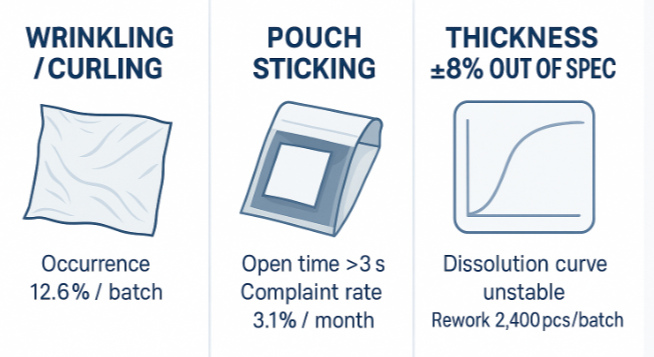 Figure: Wrinkling (12.6%/batch), Pouch sticking (3.1% monthly complaint), Thickness ±8% out of spec (~2400 pcs reworked per batch).
1. Two Misjudgments We Once Made
1) “If the formulation is right, it will dissolve fast.” ❌
When the surface wetting angle is too large, even highly soluble excipients dissolve unevenly, slowing the perceived disintegration.
2) “The thinner, the faster.” ❌
When the film thickness drops below 60 μm, mechanical strength collapses, causing wrinkling and pouch sticking—the real dissolution becomes slower.
2. The Science Behind the 3-Second Dissolution (Only Verifiable Factors)
Surface Area-to-Volume Ratio (S/V)
A thinner film and larger spreading area expose far more surface to saliva.
Tablets rely on a long “water-in / drug-out” diffusion path, while films reduce that distance to roughly h/2.Wetting and Spreading (Contact Angle θ)
A smaller contact angle allows faster capillary infiltration.
Reducing θ from 74° to 28° decreased the median T₉₀ from 78s to 31s.Mucosal Absorption Pathway
Sublingual and buccal mucosa have rich blood flow, bypassing gastric emptying.
Onset time can shorten by 20–40%, depending on the drug’s lipophilicity.
3. Data Comparison: Tablets vs. Oral Films
| Parameter | Tablets | Oral Film (h ≈ 100 μm, θ ≈ 28°) |
|---|---|---|
| T₁₀ (10% dissolved) | 40–60 s | 3–6 s |
| T₅₀ (50% dissolved) | 3–5 min | 20–35 s |
| T₉₀ (90% dissolved) | 8–12 min | 30–60 s |
| Batch RSD (T₅₀) | 12–18 % | 5–8 % |
Sensory Test (n = 24): median melt-in time = 2.2 s; full dispersion = 8–15 s.
Goal: not only faster, but more consistent.
4. Before and After: How We Made It Fast and Stable
V1 (Problem Version)
Thickness varied 60–150 μm; contact angle 60–75°; median T₉₀ = 78 s.
Users reported grainy texture, uneven melting, and occasional pouch sticking.
V2 (Improved Version)
Adjusted solvent/water ratio and final drying curve (lower temperature + mild airflow to avoid “skin-layer” hardening).
Introduced mild hydrophilic surfactant and fixed thickness at 90 ± 10 μm.
Results: median T₉₀ 31 s; RSD 17% → 7%; pouch sticking complaints ↓ by >50%.
5. Three Quick Validation Steps
30-Second Water-Dip Test — Place a film in 37 °C water, shake gently; it should almost fully disperse within 30 s.
Contact-Angle Audit — Measure three points per batch; if θ > 40°, check the final drying curve and surface system.
10-Person Blind Test — Record median and IQR of “melt-in” time; medians resist noise better than averages.
🧭 Statement of Principle
We don’t sell “one-second miracles.” We measure every second.
Speed must be real, and stability makes it a product.
📊 FAQ Section
Q1: Why can films thinner than 60 μm feel slower in real use?
Because extreme thinning weakens mechanical strength, causing wrinkling and pouch sticking. A dry “skin layer” may also form during drying, blocking saliva contact.
Q2: How do you measure the contact angle for batch control?
Use a goniometer with deionized water or simulated saliva, sample three points, and take the median.
If θ > 40°, review final drying parameters and surface-wetting composition.
Q3: What’s the difference between a perceived “3-second melt” and true dissolution?
Cooling and sweetness can enhance perceived speed but do not equal true dissolution.
Always track T₁₀/T₅₀/T₉₀ and run an n ≥ 10 blinded sensory test; report the median and interquartile range to show consistency.
Keywords: oral dissolving film, dissolution, T₉₀ 31 s, contact angle, manufacturing optimization