
Author: Sihan Meng,Leyu Zhu,Pengcheng Shi
Affiliation: RSBM
Email: pengchengshi@biotechrs.com; pcspc9@gmail.com
Abstract
Vitamin oral dissolving films (V-ODFs) provide water-free intake, fast disintegration, and precise micro-dosing. We model near-term market demand and identify priority audiences using mixed methods: analog benchmarking to size demand, persona-level willingness-to-pay (WTP) and convenience valuation, and format-share scenarios through 2032. Three figures depict channel demand forecasts, persona bubbles (WTP vs convenience importance), and a format-share shift from tablets/gummies toward ODFs. Results suggest V-ODFs can grow from niche to mid-single-digit share by 2028 and low-double-digit share by 2032 in vitamins, with retail/pharmacy remaining the larger revenue channel while DTC scales faster. Priority audiences include caregivers for children, seniors, young professionals, athletes, and pregnancy/postpartum consumers, each with distinct use-cases and price sensitivities [1–6].
Introduction
Vitamins are consumed frequently and broadly across age groups, yet tablets can be hard to swallow and gummies carry sugar and heat-stability concerns. ODFs address these barriers, enabling discreet, on-the-go intake with accurate dosing. The key commercialization questions are: how big is the near-term market, who adopts first, and what channel/messaging mix captures value? We integrate quality and usability considerations (content uniformity, taste, packaging) with demand analytics to inform product and channel strategy [1–3].
Methods
Analog triangulation: synthesized public indicators from tablets, gummies, and lozenges to derive starting values and regional/channel growth multipliers (scenario basis) [3–6].
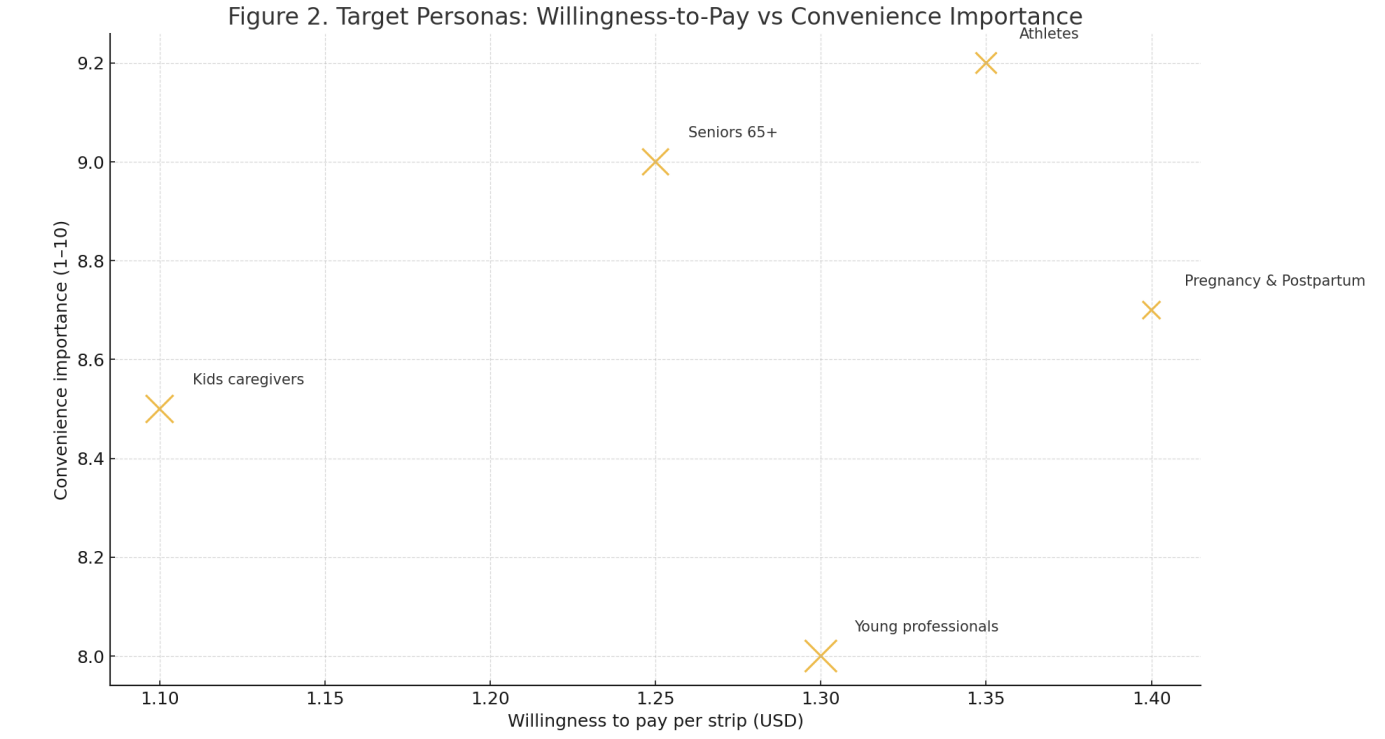
Persona modeling: five personas—kids’ caregivers, young professionals, seniors 65+, athletes, and pregnancy/postpartum—scored on convenience importance (1–10) and WTP ($/strip), with addressable population estimates.
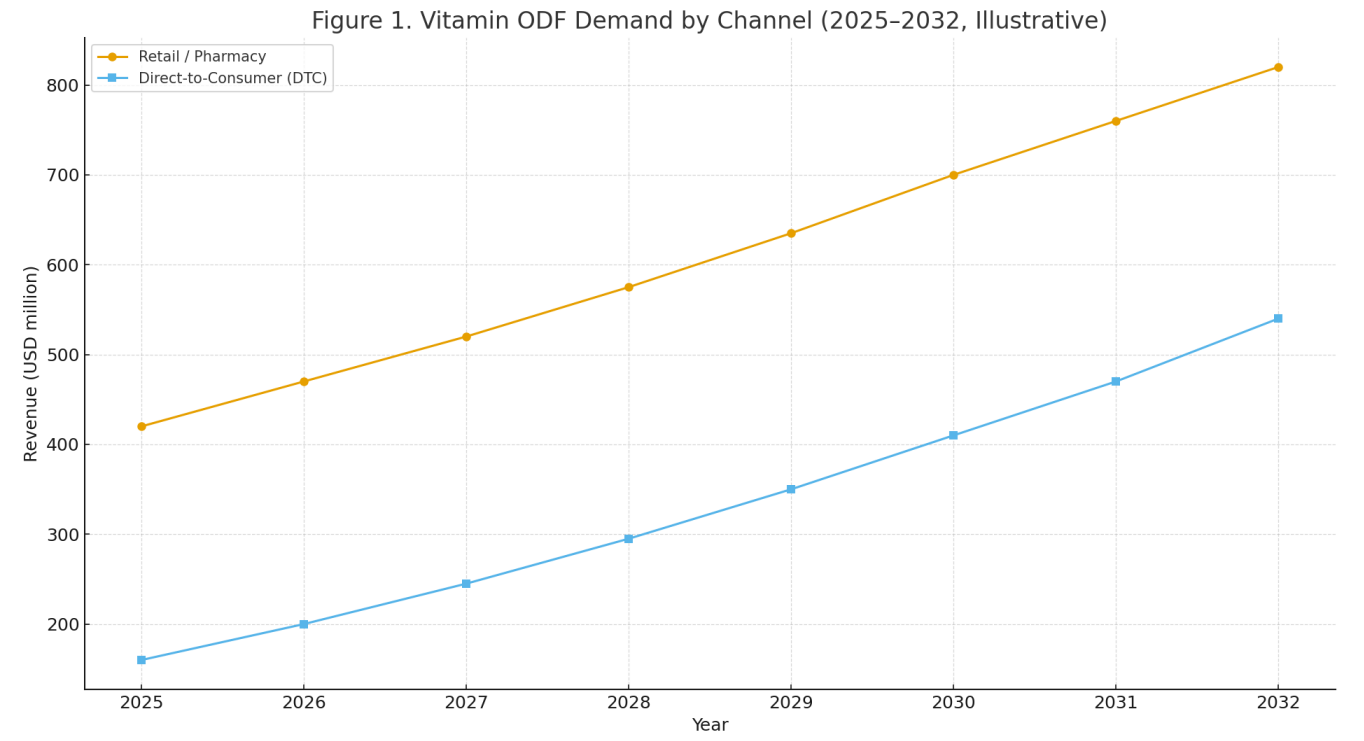
Channel forecast: top-down revenue curves for retail/pharmacy vs DTC subscriptions (2025–2032) reflecting shelf presence, planograms, and repeat-order dynamics (Figure 1).
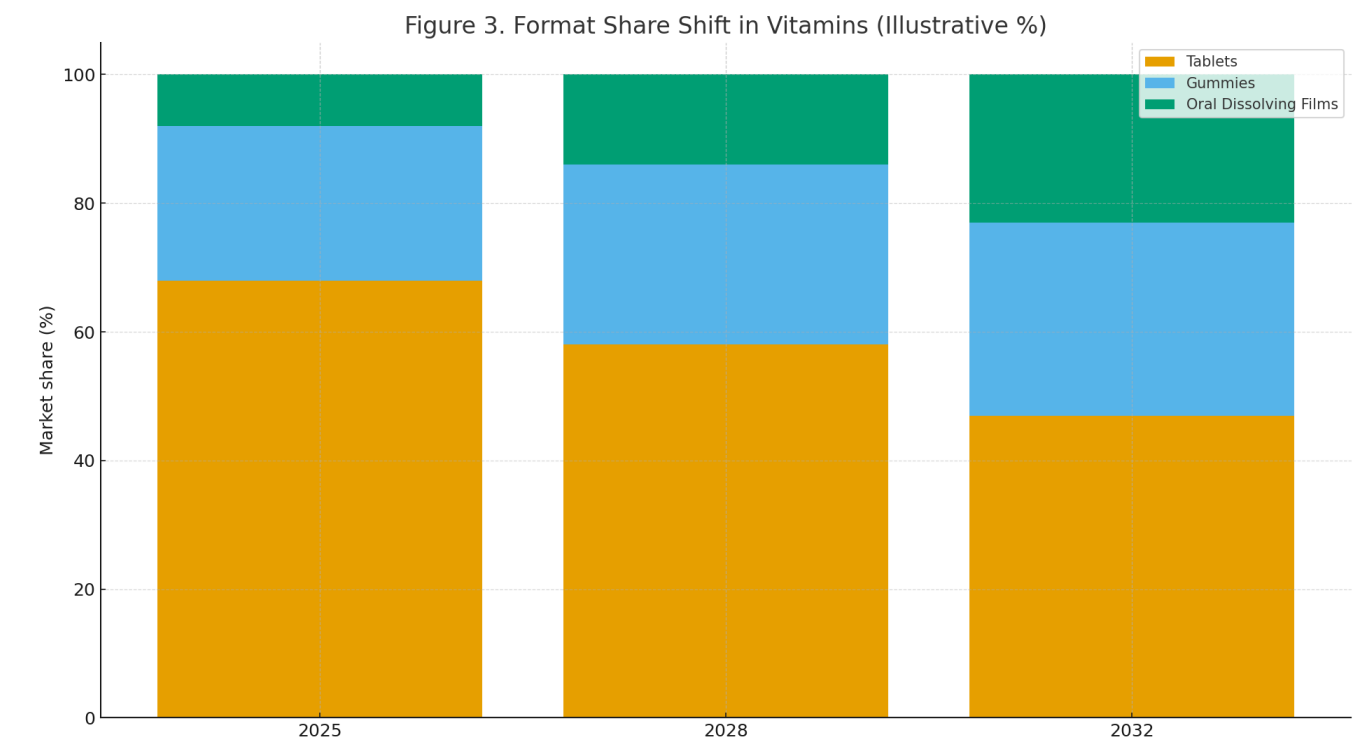
Format-share scenarios: stacked-bar projections of vitamins by form (tablets, gummies, ODF) for 2025/2028/2032 (Figure 3).
Evaluation framework: measures covering market, adoption, product quality, economics, and access.
Measures
Market: revenue by channel (USD), CAGR, and format share (%).
Adoption: persona WTP ($/strip), convenience score, and total addressable market (TAM).
Product/QoE: disintegration ≤120 s, taste ≥7/9, content RSD ≤5%, T*90 stability.
Economics: per-strip COGS and margin corridors by pack format (sachet/blister).
Access: retail coverage, e-commerce penetration, pediatric/geriatric acceptance.
Results
Channel demand trajectory. Retail/pharmacy remains the larger base, but DTC grows faster due to subscription replenishment and targeted offers (Figure 1).
Illustrative 2025→2032: retail ~$420M→~$820M; DTC ~$160M→~$540M.
Persona priorities. Bubble chart (Figure 2) indicates high convenience importance across all personas (≥8/10). WTP ranks: pregnancy/postpartum ≳ athletes ≳ seniors ≳ young professionals ≳ kids’ caregivers; TAM ranks: young professionals > kids’ caregivers > seniors > athletes > pregnancy/postpartum.
Format share shift. Vitamins move from tablets dominance toward gummies and ODFs; ODF share grows from ~8% (2025) to ~14% (2028) and ~23% (2032) in the illustrative scenario (Figure 3).
Use-case mapping.
Kids’ caregivers: daily multivitamins and travel convenience; emphasize sugar-free and child-resistant multipacks.
Seniors: swallowing difficulty and deficiency support (B12, D/K); larger font e-labels and easy-open sachets.
Young professionals: on-the-go energy/B-complex; subscribe-and-save.
Athletes: pre-/post-workout B-complex & electrolytes; sweat-resistant sachets.
Pregnancy/postpartum: folate/prenatal micronutrients; clinician-endorsed labeling.
Discussion
Positioning and channel. Retail builds trust and trials; DTC sustains adherence via subscriptions, reminders, and dynamic bundles. A dual-channel approach hedges volatility and broadens reach.
Product & packaging levers. High-barrier sachets and clean flavor systems are critical to repeat purchase; child-resistant formats for pediatric lines; recyclable secondaries for DTC.
Pricing. WTP dispersion suggests tiered packs: entry SKUs near $0.90–$1.10/strip (kids/adults daily) and premium at $1.20–$1.50/strip (prenatal/athlete).
Evidence gaps. Comparative adherence and biomarker outcomes vs gummies/tablets (e.g., serum 25-OH-D, B12) are needed to anchor claims and justify price [2].
Risks & mitigations. Flavor fatigue (rotate flavors), packaging intensity (multi-stick secondaries), and youth appeal (plain packaging and age gating where required).
Conclusion
V-ODFs occupy a defensible niche where convenience and swallowability meet dose precision. Early adoption concentrates in caregivers, seniors, and mobile adults; DTC accelerates repeat purchase, while retail ignites discovery. With robust packaging and quality, V-ODFs can achieve meaningful share gains through 2032 and complement existing vitamin formats.
References
[1] ICH Q8–Q10: Quality by Design and pharmaceutical quality system.
[2] Adherence literature for vitamins/minerals across alternative formats.
[3] USP/Ph. Eur.: dosage quality and packaging integrity considerations.
[4] Retail sell-through and planogram practices in consumer health.
[5] E-commerce subscription dynamics and replenishment models in OTC.
[6] Barrier and stability fundamentals (ASTM F1249/F1927; packaging science texts).